Concept: Converting Instagram Followers Into $15K Clients
Starting Point
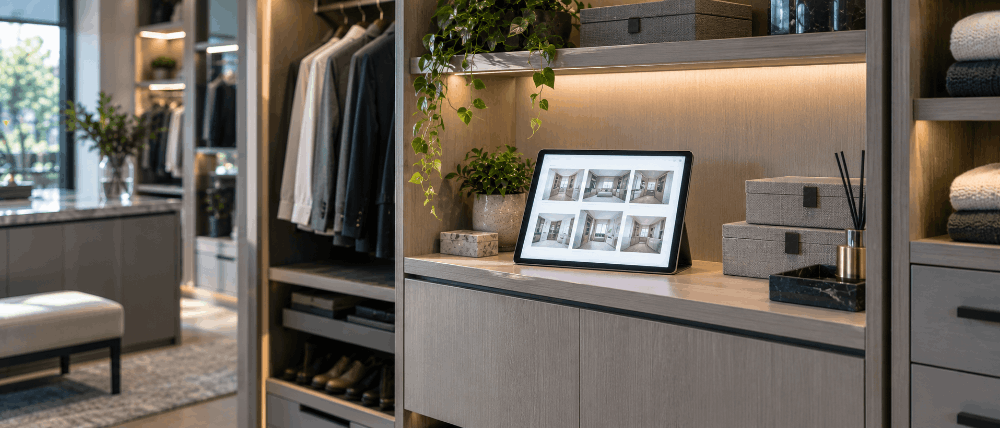
Hollis & Marsh Custom Interiors designs and builds custom closet, cabinetry, and home-organization systems — the kind of project that typically runs $3,000 to $15,000 and up. The business built a genuinely strong local reputation entirely through referrals and a well-curated Instagram account full of finished-project photography. What it never had was an actual website — just an Instagram bio link and a claimed Google Business Profile. For a while, word of mouth carried enough volume that the gap didn't seem to matter.
The Problem
It matters more than it used to, and it matters more specifically for a business at Hollis & Marsh's price point than it would for a lower-ticket local service. A 2026 consumer trust survey found businesses with websites are perceived as 41% more trustworthy than those without, and the absence of one reads as a specific, negative signal rather than a neutral one: 45% of consumers say a business without a website feels less "real," 46% perceive it as more temporary, and 39% (rising to 45% among 18–44-year-olds — Hollis & Marsh's core client age range) say they've personally declined to purchase from a business specifically because it lacked a website (DreamHost 2026 Local Business Trust Index, n=1,201 US consumers). The sharpest part of that same data is about spending comfort, and it lands squarely on a business like Hollis & Marsh: consumers report an average comfortable spend of $177 on a website versus just $36 on social media, and the gap widens dramatically at higher price points — a 7x difference in spending comfort for purchases over $100, with only 8% of consumers comfortable spending $200+ through a social media channel versus 35% comfortable doing so on a website. For a business whose average project sits well into four figures, discovery and browsing through Instagram was never going to be the problem; asking a prospect to commit real money to a project sourced entirely from a social feed, with no website to verify against, plausibly was. Contractors specifically are reported as 66% more likely to be hired when they have a website — a category close enough to custom home-organization work to take seriously. The design-quality data adds a second layer: first impressions of a website form in as little as 50 milliseconds, and research consistently finds the large majority of that snap judgment — as high as 94% in one 2026 analysis — is driven by visual design rather than the actual service or product being offered. Roughly 58% of consumers say they "often" or "always" check a business's website to verify information they first encountered on social media or Google — meaning even Hollis & Marsh's Instagram-driven leads were likely trying to cross-check the business somewhere that didn't exist, and finding nothing.
Our Approach
This wasn't a redesign — Hollis & Marsh needed a first website, built from nothing, and the strongest asset already existed: years of genuinely strong project photography validated by an engaged Instagram following. The build centered on bringing that existing photography into a proper portfolio structure organized the way a prospect actually shops for this kind of project — by room type and style, not a chronological feed — paired with a clear consultation process (what happens after you reach out, what a project timeline looks like, what materials and craftsmanship actually go into the price) that a $36-comfort-level Instagram DM was never built to convey. Given that a majority of traffic for a business like this arrives on mobile, and industry data suggests only about 22% of small-business websites are properly mobile-optimized, the build was mobile-first rather than mobile-adapted — fast image loading for a photography-heavy portfolio, and a consultation-request flow designed to be completed in a few taps, not a desktop-oriented form shrunk down to fit a phone. The website wasn't positioned to replace Instagram or the Google Business Profile — it was built as the credibility anchor those channels point back to, matching the pattern where a large share of consumers actively verify a business on its website after finding it somewhere else first.
What Changed
- A first website built from the ground up (not a redesign), organized around how prospects actually browse custom-interior projects — by room and style — rather than a chronological feed.
- Existing project photography (previously living only on Instagram) restructured into a proper portfolio with real information architecture.
- A clear, written consultation and project process added — timeline, materials, what to expect — addressing the credibility gap a social-only presence can't close for a high-ticket purchase.
- Mobile-first build prioritizing fast photo loading and a short consultation-request flow, given the majority of local-service traffic is mobile and most small-business sites in this category are not properly optimized for it.
- The website connected as the cross-reference point for Instagram and Google Business Profile traffic, matching documented consumer behavior of verifying a business's website before committing.
The Outcome
This is an unsolicited concept, not completed client work — no results have been measured for this business. The figures below are independent, cited industry data offered as context for the scale of the opportunity, not a claim of what was achieved for Hollis & Marsh specifically. The core opportunity is the spending-comfort gap itself: at a reported 7x difference in comfort for purchases over $100 between website and social-media contexts, a business whose average ticket runs into the thousands was operating almost entirely inside the channel consumers trust least with their money. Contractors seeing a 66% higher hire-likelihood with a website, and businesses overall showing a 2.8x higher likelihood of revenue growth once they have one (Google/Deloitte study of 4,500+ SMBs), both point in the same direction without promising a specific number for this business. None of this suggests Instagram was the wrong channel — it clearly worked for discovery and reputation. It suggests discovery and purchase confidence are different jobs, and only one of them had a channel built for it.
Industry Context
Premium, high-ticket local service businesses — custom interiors, high-end renovation, luxury outdoor living — increasingly hit a ceiling that lower-ticket local businesses don't feel the same way: social media is genuinely good at building visibility and reputation, but the trust and verification behavior consumers bring to a four-figure-and-up purchase decision routes through a website specifically, not the platform where they first discovered the business. For this category, "we don't need a website, our Instagram is strong" is usually true about discovery and false about closing.