Concept: Closing the 3% Gap — Turning Google Maps Visibility Into Walk-In Tables
Starting Point
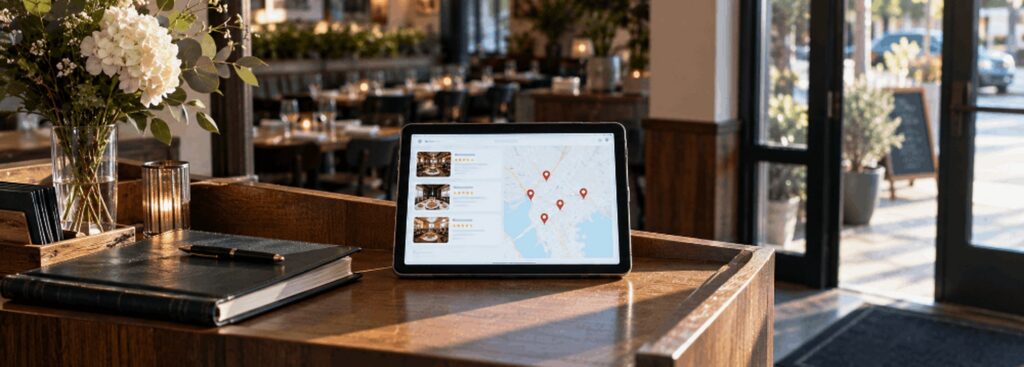
Foxglove Kitchen & Bar is an independent, 60-seat New American restaurant three years into operating in a walkable but non-downtown neighborhood of a mid-sized city — the kind of block with a wine shop, a yoga studio, and steady foot traffic, but not the tourist-heavy core where most of the city's dining press attention lands. The kitchen built a loyal following through word of mouth, a strong Instagram presence, and a menu that turns over seasonally, and its Google star rating sits comfortably above 4.5. But the owner noticed a plateau: reservations from regulars stayed steady, while the walk-in and same-night bookings that should come from people standing two blocks away searching "restaurants near me" or "brunch near me" had gone flat for over a year, even as two new competitors opened nearby. The Google Business Profile itself had been claimed at opening and largely left alone since — a handful of outdated photos, an incomplete attributes list, and no posts, Q&A activity, or review responses to speak of.
The Problem
The gap wasn't food quality or brand — it was visibility at the exact moment intent is highest. Local search behavior has shifted decisively toward habitual, map-first discovery: 84% of consumers now search online for local businesses on a daily basis (Rio SEO, Local Search Consumer Behavior Study, 2025), and nearly half — 46% — say they "always" or "often" add "near me" to those searches (Rio SEO, 2025). For a restaurant, that phrase is the moment someone is already hungry, already nearby, and picking from whichever three listings Google surfaces in the map pack. Foxglove's incomplete profile made it a weak candidate for that pack even in searches its own neighborhood should have won. Reviews compound the problem. Diners aren't skimming a star rating and moving on — 75% read at least four reviews before deciding where to go (Rio SEO, 2025), and more broadly, 97% of consumers say they read reviews for local businesses as part of their decision-making (BrightLocal, Local Consumer Review Survey, 2026). Foxglove had reviews, but almost none had owner responses, no fresh photos were being added to reinforce them, and the listing's categories and attributes (outdoor seating, reservations, dietary options) were incomplete — all signals Google's local algorithm weighs when deciding which three businesses earn map-pack placement for a given search. And placement matters enormously once a search happens: 42% of people who run a local search click on a result inside the Google Maps Pack (Backlinko, 2024) — traffic that, for an unoptimized profile, simply goes to the competitor next door instead.
Our Approach
Cyean's concept engagement starts with a full Google Business Profile audit rather than a menu or ad overhaul, treating the map pack as its own acquisition channel with its own mechanics. That means correcting and expanding primary and secondary categories to match how diners actually search (not just "restaurant," but "brunch restaurant," "New American restaurant," "restaurant with outdoor seating"), filling in every attribute Google exposes to searchers, and rebuilding the photo library around what ranks and converts — fresh, geo-tagged interior, exterior, and dish photography uploaded on a regular cadence rather than once at launch. Alongside the profile itself, the plan introduces the ongoing habits that keep a listing active in Google's eyes: weekly Google Posts tied to specials and events, a review-response workflow so every review gets a timely, human reply, a simple post-visit review-generation prompt built into the checkout flow, and proactive Q&A seeding to answer the questions diners actually ask (parking, reservations, large parties). NAP (name, address, phone) consistency is also cleaned up across the handful of directories and citation sources that feed Google's confidence in the listing.
What Changed
- Rebuilt category and attribute structure to match real "near me" and cuisine-specific search phrasing.
- Replaced a static, three-year-old photo set with a rotating library of fresh, geo-tagged dish and interior shots.
- Introduced a weekly Google Posts cadence tied to specials, events, and seasonal menu changes.
- Set up a review-response and review-generation workflow covering every new review within 48 hours.
- Cleaned up NAP consistency across citation sources feeding Google's local ranking signals.
The Outcome
This is an unsolicited concept built to illustrate an approach, not completed client work — no campaign was run for Foxglove Kitchen & Bar, and no results were measured for this specific business. The figures below are independent, cited industry data used only to size the scale of opportunity that better Google Business Profile visibility can represent for a restaurant like this, not a claim of what Foxglove achieved. That opportunity is real but modest on a per-view basis, and the two best available industry sources don't fully agree on its size. BrightLocal's Google Business Profile Insights Study, broken out by industry, puts the restaurant category at roughly a 3% views-to-action rate — meaning for every 100 people who view a restaurant's profile, about three take an action like calling, requesting directions, or visiting the website (BrightLocal, GBP Insights Study). WebFX's 2026 estimate for local businesses generally is considerably higher, in the 12–20% range (WebFX, 2026). Cyean discloses that gap openly rather than picking whichever number tells a better story: restaurants appear to sit toward the low end of what's possible, likely because a Google search for a restaurant is often just one stop in a broader browsing session across several nearby options, rather than a single-destination decision. Even using the conservative 3% figure, the arithmetic still matters at scale — a profile currently earning a few hundred monthly views converts only a handful of those into calls or direction requests, while a profile that both earns more views (through completeness and category accuracy) and lifts its action rate toward the higher end of WebFX's range compounds both sides of that equation. Layered against Rio SEO's finding that 46% of local searchers habitually search with "near me" phrasing and BrightLocal's finding that 97% of consumers read reviews before deciding, the plausible opportunity for a restaurant with Foxglove's rating but a neglected profile is meaningfully more map-pack impressions, translating — at even a conservative action rate — into more calls, more direction requests, and more first-time walk-ins during exactly the moment someone nearby is choosing where to eat.
Industry Context
The behavior underlying this concept isn't restaurant-specific optimism — it's documented, current consumer behavior. Diners now treat "near me" search as a default habit rather than an occasional shortcut, with 46% saying they always or often phrase local searches that way (Rio SEO, 2025), and once Google returns results, the map pack itself captures the click: 42% of local searchers choose a result from inside it rather than scrolling to organic listings below (Backlinko, 2024). For an independent restaurant competing against both chains with dedicated local-marketing teams and other nearby independents, an incomplete or stale Google Business Profile isn't a cosmetic gap — it's a structural disadvantage in the exact channel where hungry, nearby, high-intent customers are already looking. Sources: - Rio SEO, Local Search Consumer Behavior Study, 2025 - BrightLocal, Local Consumer Review Survey (https://www.brightlocal.com/research/local-consumer-review-survey/), 2026 - BrightLocal, Google Business Profile Insights Study (https://www.brightlocal.com/research/google-my-business-insights-study/) - Backlinko, local search / Google Maps Pack click-through data, 2024