Concept: Swapping a Paper Sign-Up Sheet for a Digital Front Door
Starting Point
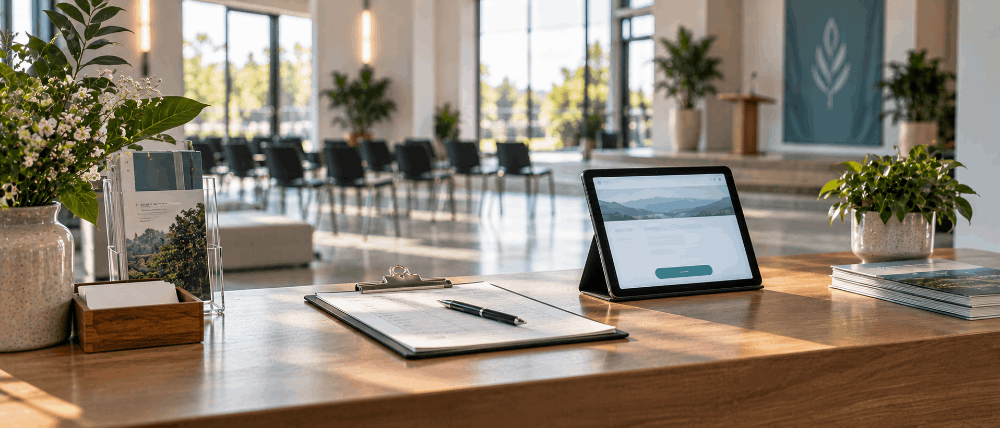
A multi-generational community worship and outreach center — regular services, a genuinely active calendar of community programs, and a website that hadn't been touched in close to a decade: a static homepage, a PDF bulletin uploaded weekly for anyone willing to download and open it, and event sign-ups handled entirely by a paper sheet at the welcome desk. Attendance at the center's programs was strong and stable; the gap was entirely between how the community actually showed up in person and how little of that activity the organization's own digital presence reflected or supported.
The Problem
The mismatch here wasn't a lack of community engagement — it was a website that couldn't keep pace with how differently each generation in that community actually expects to find and act on information. Newer and younger attendees research and sign up for things the way they do everything else: on a phone, in a few taps, without downloading a document first, and often outside of business hours, late in the evening or on a weekend when the idea of visiting occurs to them and the impulse to act on it is strongest. Longtime members still relied on the print bulletin and word of mouth, which the paper sign-up sheet served well enough — but it left the center with no reliable headcount ahead of an event, no way to reach registered attendees with a last-minute update (a room change, a weather cancellation), and no digital record of who was actually engaged in which programs, all information other organizations use routinely to plan, staff, and follow up. The absence of any online presence beyond a static page also meant the center was effectively invisible to anyone outside its existing network — a newcomer to the area, or someone searching for a welcoming community program for the first time, had almost nothing to find beyond an address and a service time, none of the texture (what an actual visit is like, what the community programs involve, whether children's programming exists) that would help a stranger decide whether to walk in the door.
Our Approach
The redesign focused on function, not aesthetics for their own sake, and deliberately stayed neutral and welcoming rather than leaning on any denomination-specific visual language, since the same site needed to work for a genuinely broad and multi-generational congregation, and ideally for a first-time visitor with no prior connection to the community at all. The static PDF bulletin was replaced with a real, mobile-readable events and announcements page, updated the same way each week but now legible directly in a browser rather than requiring a download, with automatic notifications (email or text, opt-in) for anyone who wanted to know about schedule changes without checking the site manually. Every program and event got its own simple sign-up form — name, contact detail, headcount — replacing the paper sheet with something that gives staff an actual running list instead of a stack of index cards to transcribe after the fact, and specifically extended to cover the recurring commitments the paper sheet had never handled well: volunteer sign-ups and small-group or study-program registration, both of which had previously depended entirely on someone remembering to follow up after a verbal "yes, sign me up" at the end of a service. A short "Visiting for the First Time" page was added specifically for newcomers — what to expect, what the space looks like, whether children's programming is available, parking — addressing the exact hesitations that keep an interested stranger from ever walking in, mirrored deliberately on the same principle used for the fitness studio's first-visit page in this batch: removing friction before a first visit matters as much as anything that happens after it. None of this replaced the welcome desk or the in-person sign-up sheet for those who preferred it; it simply gave everyone else a version that matched how they already do everything else online.
What Changed
- The weekly PDF bulletin replaced with a mobile-readable events and announcements page, with optional automatic notifications for schedule changes.
- A simple digital sign-up form added for every program and event, replacing the paper-only sheet, and extended to volunteer sign-ups and small-group registration for the first time.
- A "Visiting for the First Time" page added specifically for newcomers, addressing the practical hesitations that keep a first-time visitor from walking in.
- Design kept deliberately neutral and welcoming, with no denomination-specific visual language, to serve the full, multi-generational congregation and any newcomer encountering the organization for the first time.
- The in-person welcome-desk sign-up option kept in place for anyone who prefers it — digital added alongside, not instead of.
- Staff given, for the first time, a real running headcount and contact list ahead of each event rather than a stack of paper to transcribe afterward.
The Outcome
This is an unsolicited concept, not completed client work — no results have been measured for this organization, and no dollar figures apply to work of this kind in the way they might elsewhere. The change here is functional and organizational: a community that already shows up consistently now has a way to register, be reached, and be counted that matches how its newer and younger members already expect to interact with any organization, without asking its longtime members to give up what already worked for them — and a stranger encountering the organization for the first time now has enough information to actually decide to visit, rather than an address and a service time to take on faith.
Industry Context
Community and worship organizations are rarely short on engagement — the gap is almost always in the tools available to capture and act on that engagement, especially across a congregation spanning several generations with genuinely different digital habits, and in giving a first-time visitor enough to go on before they ever have the chance to be welcomed in person.