Concept: Keeping the 7% of Guests Who Drive Half of Revenue
Starting Point
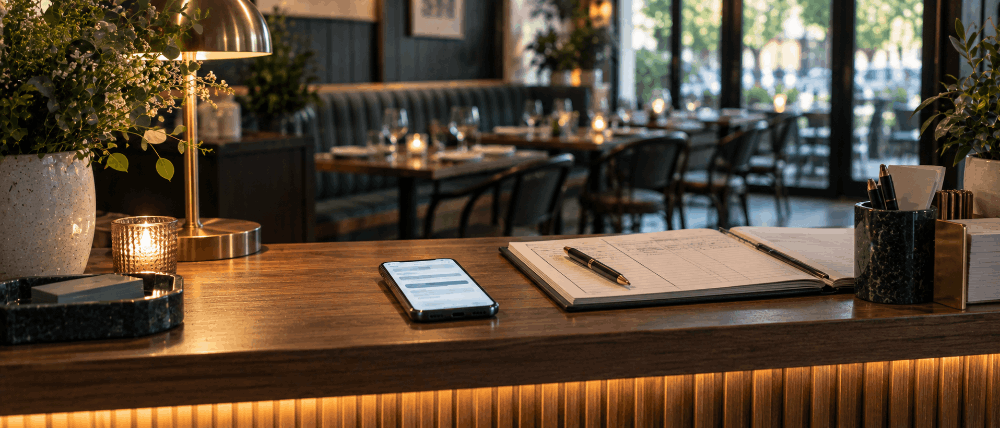
Bramwell & Rye is an eight-year-old neighborhood American bistro — the kind of place with a genuinely loyal regular crowd, a bartender who knows half the room by name, and a reservation book that fills up on weekends almost entirely through word of mouth and habit. What it never built was any system for staying in touch with those regulars between visits. No email list, no SMS program, no way to reach a guest who'd started coming in every other week and then, without any single bad experience, just quietly stopped.
The Problem
The scale of what a handful of regulars are worth is easy to underestimate. Toast's 2026 Regulars Report found that just 7% of a restaurant's guest base can generate up to 50% of total order volume — meaning a small slice of genuinely loyal guests is doing roughly half the work of keeping the business afloat, whether or not the restaurant has any system built around recognizing or retaining them. Those guests also behave differently once they're comfortable: 34% of regulars report spending more per check as familiarity grows, they're 80% more likely to try new menu items, and 77% tip more at establishments where they're known. The churn risk sitting inside that concentration is the part Bramwell & Rye had never measured. The same Toast research found that 43% of lapsed regulars didn't leave over a single bad incident — they faded gradually, and when asked why, the top reasons were a perceived quality drop (31%), price increases (22%), and service that felt less attentive over time (15%). That's a slow leak, not a dramatic exit, which means it's also the kind of churn a restaurant won't notice from the outside — a guest who visited weekly and drifted to monthly, then stopped, doesn't generate a complaint. They just disappear from a reservation book that has no way of flagging the pattern. Bramwell & Rye also had no infrastructure to catch it even if it had been watching. Loyalty program guests, per the same Toast data, retain at roughly 2x the rate of new customers and 1.5x the rate of the general guest base — and moving a guest into a loyalty relationship can shift their return rate from a 7% baseline to nearly 30%. Without an email or SMS channel, there was no mechanism to move a first-time or occasional guest into that kind of relationship at all — every guest interaction reset to zero the moment they left the building.
Our Approach
The starting point was simple: capture contact information at the moments guests were already willing to give it — at checkout via the POS, through a low-friction "join for a free appetizer" sign-up on a table tent and the website — and use it to build exactly two lists, not a single generic "everyone" blast: an SMS list for time-sensitive, high-urgency messages (a last-minute reservation opening, a same-week special), and an email list for lower-frequency, higher-context messages (a seasonal menu launch, an event invitation). Channel choice was matched deliberately to the message. Salesmsg's 2026 State of SMS Benchmark Report puts SMS open rates at roughly 98% against email's 22%, and click-through at around 45% for SMS with links versus under 5% for email — a gap large enough that any message needing same-day action (a table just opened up tonight, a flash midweek offer) went to SMS, kept under 100 characters given the platform data showing response rates drop steadily as message length climbs past that point. Email carried the messages that benefited from more context and didn't need to be read in the next hour. The most important piece wasn't a single campaign — it was the automated lifecycle sitting behind both channels: a welcome message with the promised incentive the moment someone joined, a birthday or anniversary message timed to typical celebration patterns, and, directly targeting the 43%-gradual-fade problem, a win-back sequence triggered by inactivity — a guest who'd normally visit every few weeks and hadn't shown up in that window got a specific, personal-feeling nudge before they became a guest who'd simply stopped coming without anyone at Bramwell & Rye ever knowing.
What Changed
- A unified guest contact list built for the first time, capturing email and phone at checkout and through a low-friction sign-up incentive, split into separate SMS and email lists by message urgency.
- An automated welcome message and incentive sent immediately on sign-up, replacing no structured first touch at all.
- Birthday/anniversary messages automated for the first time, tied to Toast's own finding that recognition, not just rewards, is what most guests actually want.
- An inactivity-triggered win-back sequence built specifically to catch the gradual-fade pattern before a regular becomes a former regular.
- SMS reserved for short, time-sensitive messages (under 100 characters where possible); email reserved for lower-urgency, higher-context messages — matched to each channel's own documented strengths rather than one blast list used for everything.
- Unique promo codes attached to every campaign, so redemption can be tracked back to the specific message that drove it instead of guessing at incremental revenue.
The Outcome
This is an unsolicited concept, not completed client work — no results have been measured for this business. The figures below are independent, cited industry data offered as context for the scale of the opportunity, not a claim of what was achieved for Bramwell & Rye specifically. The math starts from the concentration itself: if roughly 7% of guests already drive up to half of order volume, the highest-leverage work available to Bramwell & Rye isn't chasing new first-time visitors, it's protecting and growing that small core — and Toast's finding that loyalty-program guests return at close to 2x the rate of new ones, with return rate potentially climbing from a 7% baseline toward 30%, describes exactly that kind of protection. Layered on top, the channel data explains why email and SMS specifically are suited to this job rather than general awareness advertising: Toast's own data found 86% of email-driven orders and 83% of SMS-driven orders came from guests who'd already ordered before — these are retention channels by nature, reaching people already inclined to come back, not cold prospecting tools. None of this promises a specific recovered-revenue number for Bramwell & Rye — it describes why a restaurant with a strong but unmanaged regular base was leaving exactly the guests worth the most effort to reach with no system reaching them at all.
Industry Context
Most independent restaurants build a loyal following the way Bramwell & Rye did — organically, through consistency and genuine hospitality — and then have no infrastructure to protect what they built once it exists. The data suggests that's backwards: a small core of regulars is disproportionately responsible for revenue, they fade quietly rather than dramatically, and the channels best suited to keeping them, email and SMS, are specifically retention tools rather than acquisition ones. A restaurant that's earned genuine loyalty and never captured a phone number or email address is relying entirely on habit to keep bringing guests back, with no way to intervene the moment that habit starts to break.